

Blue rubber bands, a common and versatile item, have long been used in various fields, from office work to crafts. But have you ever wondered if they can be used for musical instruments? As a supplier of blue rubber bands, I've delved into this interesting question. In this blog, we'll explore the feasibility, potential applications, and scientific principles behind using blue rubber bands in musical instruments.
The Basics of Sound Production in Musical Instruments
Before we discuss the use of blue rubber bands in musical instruments, it's essential to understand the basic principles of sound production. Sound is created by vibrations. In musical instruments, these vibrations are usually produced by strings, membranes, or air columns. When a string is plucked, a membrane is struck, or air is blown through a tube, the resulting vibrations create sound waves that our ears perceive as music.
The pitch of the sound is determined by the frequency of the vibrations. Higher frequencies result in higher pitches, while lower frequencies produce lower pitches. The amplitude of the vibrations affects the volume of the sound, with larger amplitudes creating louder sounds.
Properties of Blue Rubber Bands
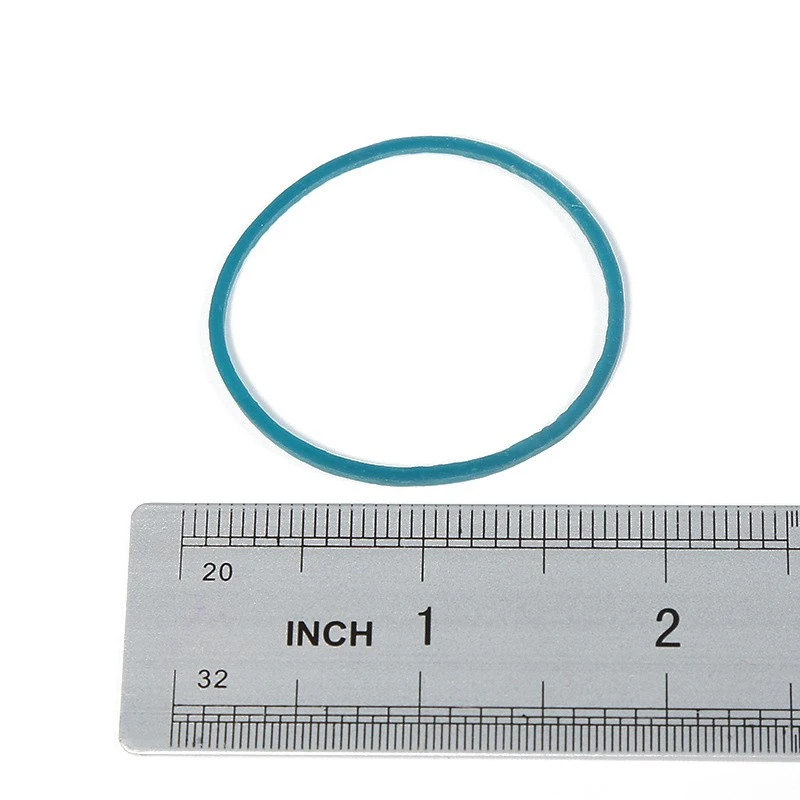
Blue rubber bands come in different shades, such as Light Blue Rubber Bands, Navy Blue Rubber Bands, and Dark Blue Rubber Bands. They are made of rubber, which is an elastic material. Elasticity is the ability of a material to return to its original shape after being stretched or deformed.
The elasticity of rubber bands allows them to store potential energy when stretched. When the rubber band is released, this potential energy is converted into kinetic energy, causing the rubber band to vibrate. These vibrations can produce sound, similar to the way a guitar string vibrates when plucked.
The thickness, length, and tension of a rubber band also affect its vibrating properties. Thicker rubber bands generally produce lower pitches because they have more mass and are more difficult to vibrate at high frequencies. Longer rubber bands also tend to produce lower pitches, as the wavelength of the vibration is longer. Tension plays a crucial role as well. Increasing the tension on a rubber band raises the pitch of the sound it produces, just like tightening a guitar string.
Using Blue Rubber Bands in DIY Musical Instruments
One of the most common ways to use blue rubber bands in musical instruments is in do - it - yourself (DIY) projects. A simple example is a rubber band guitar. You can create this instrument by stretching blue rubber bands across a box, such as a shoebox. The box acts as a resonator, amplifying the sound produced by the vibrating rubber bands.
To make a rubber band guitar, you first need to cut a hole in the top of the shoebox. This hole helps to project the sound out of the box. Then, stretch the blue rubber bands across the box, securing them at both ends. You can use different thicknesses and lengths of rubber bands to create a range of pitches. By plucking the rubber bands with your fingers, you can play simple melodies.
Another DIY instrument is a rubber band harp. Similar to the rubber band guitar, you stretch the blue rubber bands over a frame. The frame can be made of wood or plastic. You can adjust the tension of each rubber band to get the desired pitch. When you pluck the rubber bands, the harp produces a soft and soothing sound.
Scientific Experiments with Blue Rubber Bands and Sound
Scientists and educators often use blue rubber bands in experiments to teach about sound and vibrations. For example, you can conduct an experiment to study the relationship between the length of a rubber band and the pitch of the sound it produces.
First, take a single blue rubber band and stretch it between two fixed points. Pluck the rubber band and note the pitch. Then, gradually shorten the length of the rubber band by moving one of the fixed points closer. Each time you shorten the rubber band, pluck it again and observe how the pitch changes. You'll find that as the length of the rubber band decreases, the pitch increases.
Another experiment can focus on the effect of tension. Fix a blue rubber band between two points and pluck it to establish a baseline pitch. Then, increase the tension on the rubber band by pulling it tighter. Pluck the rubber band again, and you'll notice that the pitch has gone up. These experiments not only demonstrate the scientific principles of sound production but also show the potential of blue rubber bands in musical applications.
Limitations and Challenges
While blue rubber bands can be used to create simple musical instruments, they do have some limitations. One of the main limitations is the durability of rubber. Rubber bands can wear out over time, especially if they are constantly stretched and released. This can affect the consistency of the sound produced by the instrument.
Another challenge is the range of pitches that can be achieved. Compared to traditional musical instrument strings, rubber bands have a more limited pitch range. It can be difficult to get very high or very low pitches with rubber bands, and the quality of the sound may not be as rich or pure as that of professional musical instruments.
Commercial and Professional Applications
Despite the limitations, there may be some commercial and professional applications for blue rubber bands in the musical field. For example, in the world of experimental music, musicians are always looking for new and unique sounds. Blue rubber bands could be incorporated into custom - made musical instruments to add a distinct timbre.
In the educational sector, blue rubber bands can be used in music classes to teach students about the basics of sound and instrument construction. They are inexpensive, readily available, and easy to work with, making them an ideal material for hands - on learning.

Conclusion
In conclusion, blue rubber bands can indeed be used for musical instruments. They offer a simple and accessible way to explore the world of sound and music. Whether you're a DIY enthusiast, a science educator, or an experimental musician, blue rubber bands have the potential to create interesting and unique sounds.
As a supplier of blue rubber bands, we offer a wide range of options, including Light Blue Rubber Bands, Navy Blue Rubber Bands, and Dark Blue Rubber Bands. If you're interested in using our blue rubber bands for musical instrument projects or other applications, we'd love to hear from you. Contact us to discuss your procurement needs and explore the possibilities together.
References
- Hall, D. E. (2010). Musical Acoustics. Brooks/Cole.
- Fletcher, N. H., & Rossing, T. D. (1998). The Physics of Musical Instruments. Springer.
- Hewitt, P. G. (2014). Conceptual Physics. Pearson.