

Do green rubber bands stick to certain surfaces? This is a question that has intrigued both casual users and industry professionals alike. As a supplier of green rubber bands, I've had the opportunity to observe their behavior on various surfaces and conduct some informal experiments. In this blog post, I'll share my insights and findings on this topic.
The Science Behind Rubber Band Adhesion
To understand whether green rubber bands stick to certain surfaces, we first need to delve into the science of adhesion. Adhesion is the attraction between two different substances that causes them to stick together. In the case of rubber bands, adhesion can occur due to several factors, including surface roughness, surface energy, and the presence of any contaminants.
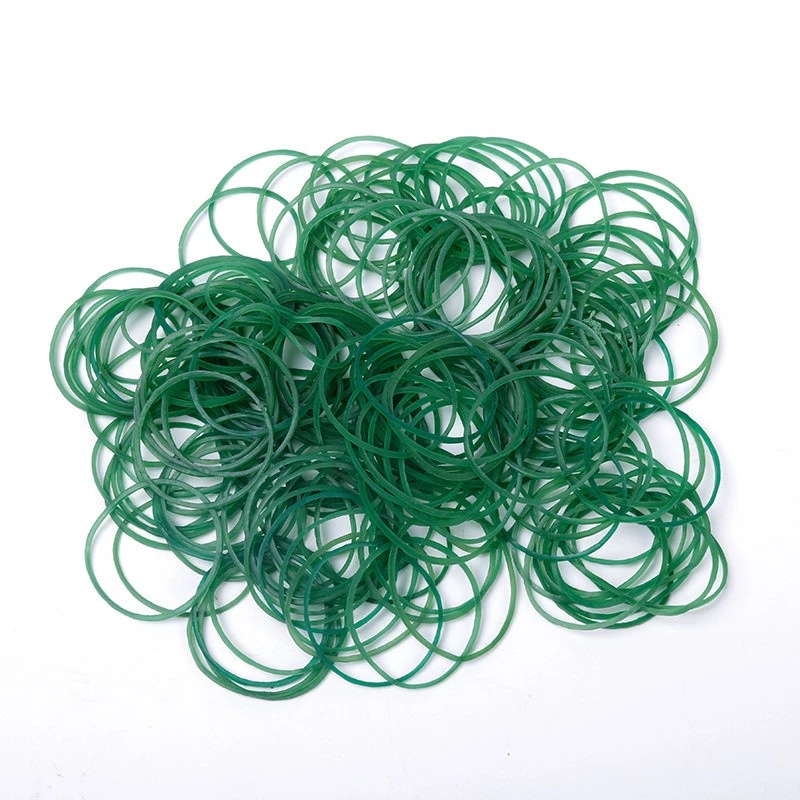

Rubber is a polymer material, which means it consists of long chains of molecules. These molecules can interact with the molecules on the surface they come into contact with through various forces, such as van der Waals forces, hydrogen bonding, and electrostatic forces. The strength of these interactions depends on the nature of the surface and the rubber band.
Factors Affecting Adhesion
Surface Roughness
One of the key factors that influence the adhesion of rubber bands is the roughness of the surface. A rough surface provides more contact area for the rubber band to grip onto, which can increase the adhesion. For example, a piece of sandpaper has a very rough surface, and a rubber band is likely to stick to it better than to a smooth glass surface.
On the other hand, a smooth surface has less contact area, and the rubber band may not be able to form as many bonds with the surface. This can result in weaker adhesion. However, it's important to note that even on a smooth surface, there can still be some adhesion due to the van der Waals forces between the rubber and the surface.
Surface Energy
Surface energy is another important factor that affects adhesion. Surface energy is a measure of the energy required to create a new surface. Surfaces with high surface energy tend to have stronger adhesion with rubber bands because they can form more bonds with the rubber molecules.
For example, metals and ceramics generally have high surface energy, and rubber bands are likely to stick to them better than to plastics, which typically have lower surface energy. However, the adhesion can also be affected by the presence of any surface treatments or coatings on the material.
Contaminants
Contaminants on the surface can also have a significant impact on the adhesion of rubber bands. For example, if the surface is dirty or greasy, the rubber band may not be able to make direct contact with the surface, which can reduce the adhesion. Similarly, if the rubber band itself is contaminated with dirt or oil, it may not stick as well to the surface.
Surfaces and Their Adhesion with Green Rubber Bands
Now that we understand the factors that affect adhesion, let's take a look at some common surfaces and how green rubber bands interact with them.
Glass
Glass is a smooth surface with relatively low surface energy. As a result, green rubber bands may not stick very well to glass. However, if the glass surface is clean and dry, there can still be some adhesion due to the van der Waals forces. In some cases, the rubber band may be able to form a weak seal with the glass, which can be useful for certain applications.
Wood
Wood is a porous and rough surface, which provides a good amount of contact area for the rubber band to grip onto. Green rubber bands are likely to stick well to wood, especially if the wood is untreated or has a natural finish. However, if the wood is coated with a smooth paint or varnish, the adhesion may be reduced.
Metal
Metals generally have high surface energy, which makes them good candidates for adhesion with green rubber bands. The rough surface of some metals, such as aluminum or steel, can also provide additional grip for the rubber band. However, the adhesion can be affected by the presence of any rust or oxidation on the metal surface.
Plastic
Plastics have a wide range of surface energies, depending on the type of plastic. Some plastics, such as polycarbonate or acrylic, have relatively high surface energy and may have good adhesion with green rubber bands. Other plastics, such as polyethylene or polypropylene, have lower surface energy and may not stick as well.
Applications of Green Rubber Bands Based on Adhesion
The adhesion properties of green rubber bands can be exploited in various applications. For example, in the packaging industry, rubber bands are often used to secure items together. If the item has a surface that the rubber band can stick to well, it can provide a more secure hold.
In the craft and DIY industry, green rubber bands can be used for a variety of projects. Their ability to stick to certain surfaces can be useful for creating decorative elements or for holding materials in place during the crafting process.
Our Green Rubber Band Products
As a supplier of green rubber bands, we offer a wide range of products to meet different needs. Our Neon Green Rubber Bands are bright and eye - catching, making them perfect for decorative purposes. They have good elasticity and can adhere to many surfaces to some extent.
Our Small Green Rubber Bands are ideal for small - scale applications, such as bundling small items or for use in crafts. They are easy to handle and can stick to surfaces like paper and cardboard effectively.
Our Green Elastic Rubber Bands are made from high - quality rubber, which gives them excellent elasticity and adhesion properties. They can be used in a variety of industries, from office supplies to industrial applications.
Contact Us for Procurement
If you're interested in purchasing our green rubber bands, we'd love to hear from you. Whether you need them for a small - scale project or a large - scale industrial application, we can provide you with the right products at competitive prices. Contact us today to discuss your requirements and start a procurement negotiation.
References
- "Adhesion and Friction: Science and Technology" by K. L. Mittal
- "Polymer Science: A Comprehensive Reference" edited by Krzysztof Matyjaszewski and Michael S. Silverstein