

Do large rubber bands break when stretched too far? This is a question that many of us have pondered, whether we're using them for everyday tasks or in industrial settings. As a supplier of large rubber bands, I've had the opportunity to delve deep into the science behind these versatile tools and understand their limitations when it comes to stretching.
The Science Behind Rubber Band Stretchability
To comprehend why rubber bands behave the way they do when stretched, we need to understand their molecular structure. Rubber is composed of long, coiled polymer chains. When a rubber band is at rest, these chains are in a relaxed, disordered state. However, when you stretch a rubber band, these chains straighten out and align in the direction of the stretch.
This alignment is due to the applied force overcoming the natural entropy of the polymer chains. Entropy, in simple terms, is a measure of disorder. The polymer chains in a rubber band naturally prefer a disordered state, but stretching forces them into a more ordered arrangement.
The ability of a rubber band to stretch is also related to its elasticity. Elasticity is the property of a material to return to its original shape after being deformed. In the case of rubber bands, this is due to the intermolecular forces between the polymer chains. These forces act like springs, pulling the chains back to their original coiled state once the stretching force is removed.
Factors Affecting Rubber Band Breakage
While rubber bands are highly elastic, they do have their limits. Several factors can contribute to a rubber band breaking when stretched too far.
Material Quality
The quality of the rubber used in the band plays a significant role in its stretchability and durability. High - quality rubber bands are made from natural rubber or synthetic rubber compounds that are formulated to have better elasticity and strength. For example, our High Strength Rubber Bands are crafted from premium materials, which can withstand greater stretching forces compared to lower - quality bands.
Temperature
Temperature also affects the behavior of rubber bands. At lower temperatures, rubber becomes stiffer and less elastic. The polymer chains have less mobility, and the intermolecular forces become stronger. As a result, the rubber band is more likely to break when stretched. Conversely, at higher temperatures, rubber becomes more flexible, but it can also lose its strength over time due to thermal degradation.
Age and Exposure
Over time, rubber bands can degrade due to exposure to oxygen, sunlight, and chemicals. Oxidation can cause the polymer chains to break down, reducing the band's elasticity and strength. Sunlight, especially ultraviolet (UV) radiation, can also accelerate this degradation process. Chemicals such as oils, solvents, and acids can react with the rubber, causing it to swell, harden, or become brittle.
Testing the Limits of Large Rubber Bands
To determine how far large rubber bands can be stretched before breaking, we conduct a series of tests in our laboratory. We use a tensile testing machine, which applies a controlled force to the rubber band until it breaks. The machine measures the force applied and the amount of stretch at the point of breakage.
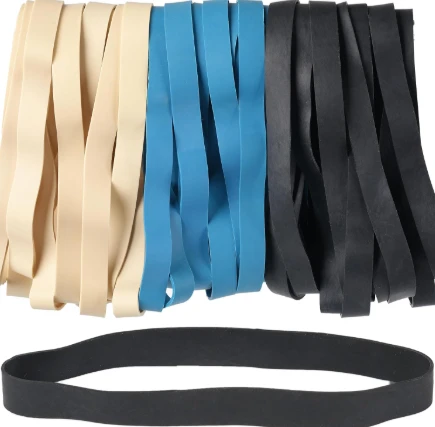
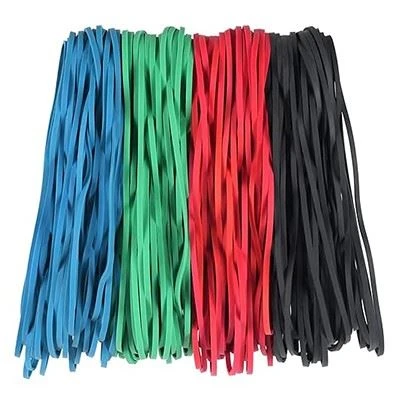
In our tests, we've found that the breaking point of large rubber bands can vary significantly depending on their size, thickness, and material composition. For example, our Industrial Strength Elastic Bands are designed to withstand much higher stretching forces compared to standard rubber bands. These bands are often used in heavy - duty applications where reliability is crucial.
Applications of Large Rubber Bands
Large rubber bands have a wide range of applications, from household use to industrial settings.
Household Use
In the home, large rubber bands can be used for organizing items, bundling cables, or even as a makeshift clothesline. Our Large Colored Rubber Bands are not only functional but also add a splash of color to your organization efforts.
Industrial Use
In industrial settings, large rubber bands are used in packaging, manufacturing, and transportation. They can be used to secure products, hold components together, or provide tension in machinery. The high strength and elasticity of our industrial - grade rubber bands make them ideal for these demanding applications.
How to Avoid Premature Rubber Band Breakage
To ensure that your large rubber bands last longer and don't break prematurely, there are several steps you can take.
Store Properly
Store rubber bands in a cool, dry place away from direct sunlight and chemicals. A sealed container or a drawer can help protect them from oxidation and environmental damage.
Use the Right Size and Type
Choose the right size and type of rubber band for your application. Using a rubber band that is too small or of low quality for a particular task can increase the risk of breakage. Our team of experts can help you select the most suitable rubber bands for your needs.
Avoid Over - stretching
Be mindful of how far you stretch the rubber band. If you need to apply a large amount of force, consider using multiple rubber bands or a stronger type of band.
Conclusion
In conclusion, large rubber bands do break when stretched too far, but the exact point of breakage depends on several factors such as material quality, temperature, age, and exposure. As a supplier of high - quality large rubber bands, we are committed to providing products that offer the best combination of stretchability and durability.
Whether you're looking for Industrial Strength Elastic Bands for heavy - duty applications or Large Colored Rubber Bands for household use, we have a wide range of options to meet your needs. If you're interested in learning more about our products or would like to discuss a potential purchase, please don't hesitate to contact us. We're here to help you find the perfect rubber band solutions for your business or personal use.
References
- "The Physics of Rubber Elasticity" by L. R. G. Treloar
- "Polymer Science and Technology" by Donald R. Paul and Charles A. Wilkie