

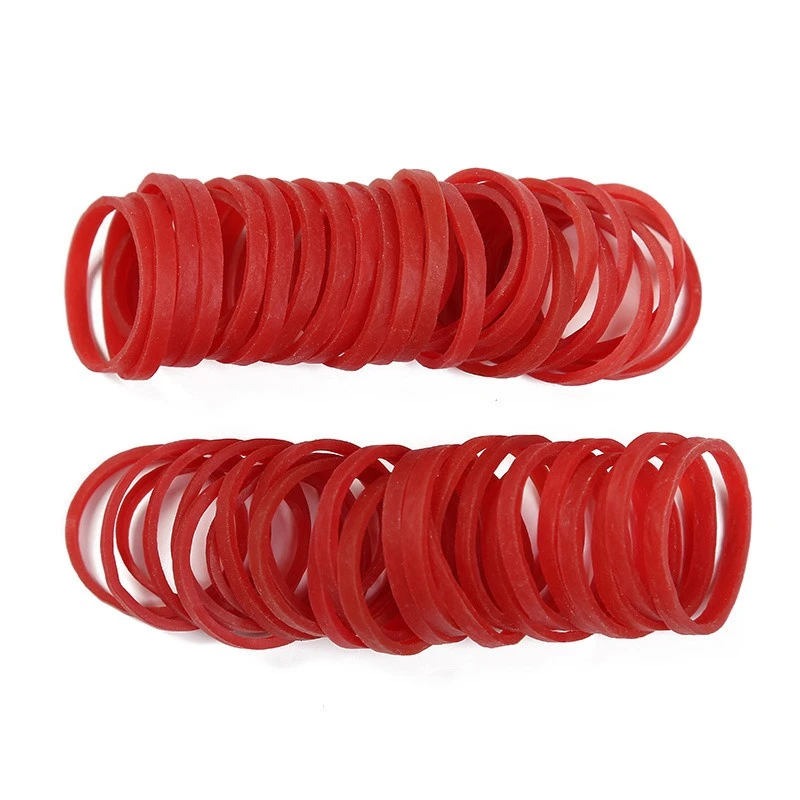
Red rubber bands are a common and versatile item used in various settings, from offices and schools to homes and industries. However, a question that often arises is whether these red rubber bands leave marks on objects. As a supplier of high - quality red rubber bands, I'm here to explore this topic in detail, offering insights based on scientific knowledge and real - world experience.
The Composition of Red Rubber Bands
To understand whether red rubber bands leave marks, we first need to look at their composition. Red rubber bands are typically made from natural or synthetic rubber. Natural rubber is derived from the latex of rubber trees, while synthetic rubber is chemically produced. The red color is usually achieved by adding pigments during the manufacturing process.
Pigments are substances that provide color to the rubber. They can be organic or inorganic. Organic pigments are often made from carbon - based compounds, while inorganic pigments are typically metal oxides. The type of pigment used can have an impact on whether the rubber band leaves marks. Inorganic pigments are generally more stable and less likely to bleed compared to some organic pigments.
Factors Affecting Marking
1. Time of Contact
The longer a red rubber band is in contact with an object, the higher the chance of it leaving a mark. Over time, the rubber can transfer some of its pigments or other substances onto the surface of the object. For example, if you use a red rubber band to bundle papers and leave it there for several weeks or months, you might notice a faint red mark on the papers. This is because the pigments in the rubber band gradually seep out and adhere to the paper fibers.
2. Temperature and Humidity
Environmental conditions play a significant role. High temperatures can cause the rubber to become more pliable and increase the mobility of the pigments. Similarly, high humidity can create a moist environment that may facilitate the transfer of pigments. In a hot and humid room, a red rubber band left on a wooden surface may leave a more noticeable mark compared to the same rubber band in a cool and dry environment.
3. Surface Material of the Object
Different materials react differently to the contact with red rubber bands. Porous materials like paper, fabric, and some types of wood are more likely to absorb pigments from the rubber band. On the other hand, non - porous materials such as glass, metal, and plastic are generally less prone to marking. However, if the surface of the non - porous material has scratches or micro - pores, it may still accumulate some marks over time.
4. Quality of the Rubber Band
The quality of the red rubber band also matters. High - quality rubber bands are made with better - quality pigments and manufacturing processes. These pigments are more firmly bound to the rubber matrix, reducing the likelihood of bleeding. Cheaper rubber bands may use lower - grade pigments that are more likely to transfer onto objects. As a supplier, we take pride in offering Red And Green Rubber Bands that are made with high - quality materials and strict quality control measures to minimize the risk of marking.
Scientific Explanation of Marking
The process of a red rubber band leaving a mark on an object can be explained by diffusion. Diffusion is the movement of particles from an area of high concentration to an area of low concentration. In the case of red rubber bands, the pigments in the rubber are in a relatively high concentration within the rubber matrix. When the rubber band comes into contact with an object, the pigments can diffuse out of the rubber and onto the object's surface.
The rate of diffusion is affected by the factors mentioned above. For instance, higher temperatures increase the kinetic energy of the pigment particles, allowing them to move more freely and diffuse more quickly. The surface properties of the object also influence diffusion. Porous surfaces provide more spaces for the pigment particles to penetrate, enhancing the diffusion process.
Testing and Observation
To better understand the marking behavior of red rubber bands, we conducted a series of tests. We used our Big Red Rubber Bands and Thick Red Rubber Bands and applied them to different materials, including paper, wood, glass, and plastic.
We placed the rubber bands on the materials for different periods of time, ranging from a few days to several weeks. We also varied the environmental conditions, such as temperature and humidity. The results showed that paper was the most likely to be marked, especially after long - term contact. Wood also showed some marking, but it was less pronounced compared to paper. Glass and plastic showed minimal to no marking, even after extended periods of contact.
Minimizing Marking
If you want to use red rubber bands without worrying about marks, here are some tips:
- Limit Contact Time: Remove the rubber band as soon as it is no longer needed.
- Choose the Right Surface: Avoid using red rubber bands on porous or easily - marked surfaces for long periods.
- Store Properly: Keep red rubber bands in a cool and dry place to maintain their quality and reduce the risk of pigment transfer.
Our Commitment as a Supplier
As a supplier of red rubber bands, we are committed to providing products that meet the highest quality standards. We use high - grade pigments and advanced manufacturing techniques to ensure that our red rubber bands are less likely to leave marks on objects. Our Red And Green Rubber Bands, Big Red Rubber Bands, and Thick Red Rubber Bands are carefully tested to ensure their performance and quality.
If you are in the market for red rubber bands for your office, school, or industrial needs, we invite you to contact us for a purchase negotiation. We can offer you a wide range of red rubber bands at competitive prices and with excellent customer service. Whether you need a small quantity for personal use or a large order for your business, we are here to meet your requirements.

References
- "The Science of Rubber and Its Applications" - A textbook on rubber materials and their properties.
- "Diffusion in Polymers" - A research paper on the diffusion of substances in polymer - based materials like rubber.
- In - house testing reports on the marking behavior of red rubber bands.