

Do small rubber bands lose their elasticity over time?
As a supplier of small rubber bands, I've often been asked whether these seemingly simple yet incredibly useful items lose their elasticity over time. It's a question that delves into the science of materials and has practical implications for both our customers and our business. In this blog, I'll explore the factors that affect the elasticity of small rubber bands and provide insights based on scientific knowledge and real - world experience.
The Science of Rubber Elasticity
To understand whether small rubber bands lose their elasticity, we first need to understand what gives rubber its elastic properties. Rubber is a polymer, which means it's made up of long chains of molecules. These chains are flexible and can be stretched. When a rubber band is stretched, the polymer chains straighten out. Once the stretching force is removed, the chains return to their original, coiled shape, causing the rubber band to contract back to its original size.
This ability to stretch and return to its original shape is due to the intermolecular forces between the polymer chains. These forces are relatively weak, allowing the chains to move past each other when stretched. However, they are strong enough to pull the chains back together when the stretching force is removed.
Factors Affecting Elasticity Over Time
There are several factors that can cause small rubber bands to lose their elasticity over time.
1. Oxidation
One of the primary factors is oxidation. Rubber is susceptible to oxidation when it comes into contact with oxygen in the air. Oxidation causes chemical changes in the rubber polymer chains. The oxygen molecules react with the double bonds in the polymer chains, breaking them and creating cross - links between the chains. As these cross - links form, the polymer chains become more rigid and less able to move past each other. This results in a reduction in the rubber band's ability to stretch and return to its original shape.
The rate of oxidation can be affected by environmental factors such as temperature and humidity. Higher temperatures generally increase the rate of oxidation, as the heat provides more energy for the chemical reactions to occur. Humidity can also play a role, as water can act as a catalyst for some of the oxidation reactions.
2. Exposure to Light
Exposure to light, especially ultraviolet (UV) light, can also cause small rubber bands to lose their elasticity. UV light has enough energy to break the chemical bonds in the rubber polymer chains. This can lead to the formation of free radicals, which are highly reactive molecules. These free radicals can then react with other molecules in the rubber, causing further damage to the polymer chains. Over time, this damage accumulates, and the rubber band becomes more brittle and less elastic.
3. Mechanical Stress
Repeated stretching and relaxation of small rubber bands can also lead to a loss of elasticity. Each time a rubber band is stretched, some of the polymer chains are permanently deformed. This is because the stretching can cause the chains to break or become misaligned. As more and more chains are damaged over repeated use, the rubber band's ability to stretch and return to its original shape decreases.
4. Contact with Chemicals
Contact with certain chemicals can also affect the elasticity of small rubber bands. For example, oils, solvents, and some cleaning agents can dissolve or swell the rubber. This can disrupt the structure of the polymer chains and reduce the rubber band's elasticity. Some chemicals can also react with the rubber, causing chemical changes that lead to a loss of elasticity.
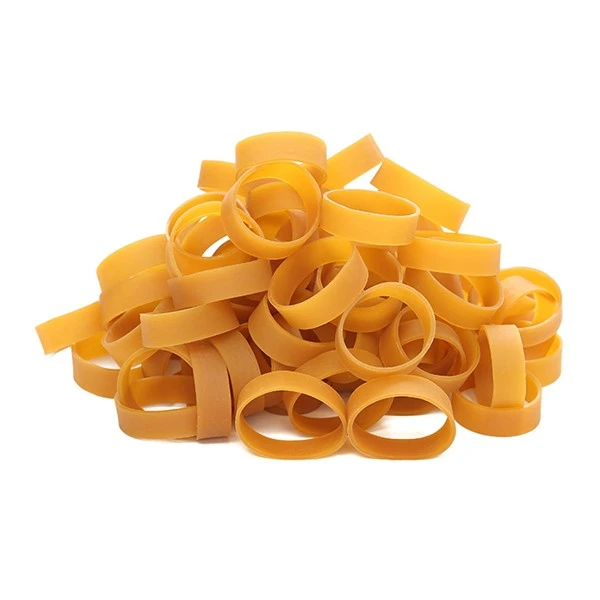

Real - World Observations
In our experience as a small rubber bands supplier, we've noticed that the rate at which rubber bands lose their elasticity can vary widely depending on how they are stored and used. For example, rubber bands that are stored in a cool, dark, and dry place tend to retain their elasticity for much longer than those that are exposed to high temperatures, sunlight, or humidity.
We've also found that different types of small rubber bands can have different rates of elasticity loss. For instance, Short Rubber Bands may be more prone to mechanical stress due to their shorter length, which could potentially lead to a faster loss of elasticity if they are used frequently. Little Rubber Bands and Micro Rubber Bands, on the other hand, may be more affected by oxidation and light exposure because of their small size, which gives them a relatively large surface area compared to their volume.
Mitigating Elasticity Loss
To help our customers preserve the elasticity of their small rubber bands, we recommend the following storage and usage practices:
- Storage: Store rubber bands in a cool, dry, and dark place. A sealed container or a drawer away from direct sunlight and heat sources is ideal.
- Avoid Chemical Exposure: Keep rubber bands away from oils, solvents, and cleaning agents. If they do come into contact with chemicals, wash them gently with mild soap and water and let them dry thoroughly.
- Limit Mechanical Stress: Avoid over - stretching rubber bands and try to use them within their recommended stretch limits. If possible, rotate the rubber bands in use to distribute the mechanical stress evenly.
Implications for Our Business and Customers
As a small rubber bands supplier, understanding the factors that affect elasticity is crucial for us. It allows us to provide better products and advice to our customers. We can ensure that our rubber bands are made with high - quality materials and manufacturing processes that minimize the effects of oxidation, light exposure, and mechanical stress.
For our customers, knowing how to preserve the elasticity of small rubber bands can save them money in the long run. By following the recommended storage and usage practices, they can extend the lifespan of their rubber bands and reduce the frequency of replacements.
Conclusion
In conclusion, small rubber bands do lose their elasticity over time due to factors such as oxidation, exposure to light, mechanical stress, and contact with chemicals. However, by understanding these factors and taking appropriate measures to mitigate them, both we as a supplier and our customers can ensure that the rubber bands maintain their elasticity for as long as possible.
If you're interested in purchasing high - quality small rubber bands or have any questions about their storage and usage, we'd love to hear from you. Contact us to start a procurement discussion and find the perfect small rubber bands for your needs.
References
- Mark, J. E. (2007). Physical Properties of Polymers Handbook. Springer.
- Sperling, L. H. (2006). Introduction to Physical Polymer Science. Wiley.