

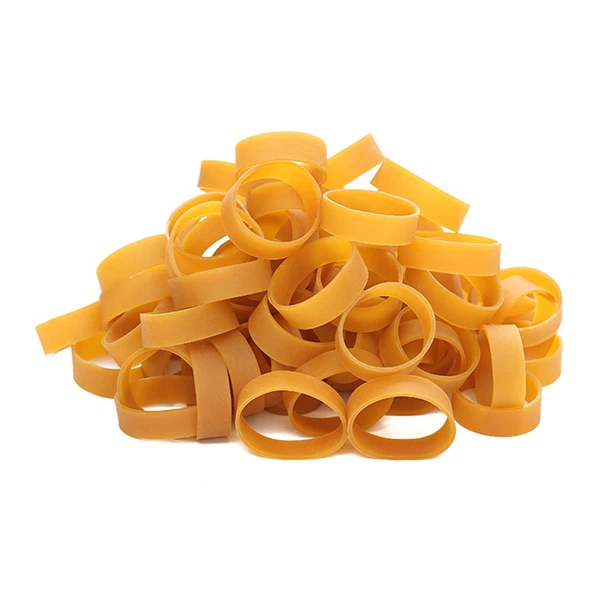
Measuring the elasticity of a yellow rubber band is not only a fascinating scientific endeavor but also crucial for a supplier like me. As a provider of various yellow rubber bands, including Yellow Rubber Rings, Small Yellow Rubber Band, and Thick Yellow Rubber Band, understanding their elastic properties helps in ensuring product quality and meeting customer needs. In this blog, I will explore the methods and concepts behind measuring the elasticity of these vibrant yellow rubber bands.
Understanding Elasticity
Before delving into the measurement techniques, it's essential to understand what elasticity means. Elasticity is the ability of a material to return to its original shape after being deformed. In the case of a rubber band, when we stretch it, it elongates, and when we release it, it should go back to its initial length. This property is governed by Hooke's Law, which states that the force needed to stretch or compress a spring (or in our case, a rubber band) is directly proportional to the displacement of the spring from its equilibrium position, within the elastic limit.
Mathematically, Hooke's Law can be expressed as (F = kx), where (F) is the force applied, (x) is the displacement from the equilibrium position, and (k) is the spring constant (or in the context of a rubber band, the elastic constant). The elastic constant (k) is a measure of the stiffness of the rubber band. A higher (k) value indicates a stiffer rubber band that requires more force to stretch.
Factors Affecting Rubber Band Elasticity
Several factors can influence the elasticity of a yellow rubber band. The material composition is a primary factor. Rubber bands are typically made from natural rubber or synthetic rubber compounds. Natural rubber has excellent elasticity due to its long polymer chains that can stretch and recoil easily. Synthetic rubbers, on the other hand, can be engineered to have specific properties, such as increased durability or resistance to chemicals.
The thickness and width of the rubber band also play a role. A Thick Yellow Rubber Band generally has a higher elastic constant than a thinner one because it has more material to resist deformation. Similarly, a wider rubber band can distribute the applied force over a larger area, affecting its stretching behavior.
Temperature is another crucial factor. Rubber bands become more elastic at higher temperatures because the increased thermal energy allows the polymer chains to move more freely. At lower temperatures, the rubber band becomes stiffer and may even lose some of its elasticity.
Measuring Elasticity: Experimental Setup
To measure the elasticity of a yellow rubber band, we can set up a simple experiment using basic equipment. Here's what you'll need:
- A yellow rubber band (you can choose from Yellow Rubber Rings, Small Yellow Rubber Band, or Thick Yellow Rubber Band)
- A stand or a clamp to hold the rubber band
- A ruler or a measuring tape
- A set of weights with known masses
Step 1: Prepare the Rubber Band
First, measure the initial length (L_0) of the rubber band when it is in its relaxed state. Make sure to measure it carefully, as this will be the reference point for all subsequent measurements.
Step 2: Set Up the Experiment
Attach one end of the rubber band to the stand or clamp, ensuring that it is secure. Hang the other end of the rubber band freely. Place the ruler or measuring tape vertically next to the rubber band, with the zero mark at the point where the rubber band is attached.
Step 3: Apply Weights and Measure Displacement
Start by adding a small weight to the free end of the rubber band. Wait for the rubber band to come to rest, and then measure the new length (L_1) of the rubber band. Calculate the displacement (x = L_1 - L_0).
The force applied by the weight can be calculated using the formula (F = mg), where (m) is the mass of the weight and (g) is the acceleration due to gravity ((g = 9.81 m/s^2)).
Repeat this process by adding more weights one by one, measuring the new length of the rubber band each time and calculating the corresponding displacement and force. Make sure not to exceed the elastic limit of the rubber band, as this will cause permanent deformation.
Analyzing the Data
Once you have collected a set of data points (force (F) and displacement (x)), you can plot a graph of force versus displacement. According to Hooke's Law, within the elastic limit, the graph should be a straight line. The slope of this line is equal to the elastic constant (k) of the rubber band.
You can use a linear regression analysis to find the best-fit line for your data points. Most spreadsheet software, such as Microsoft Excel or Google Sheets, has built-in functions for linear regression. The equation of the best-fit line will be in the form (y = mx + b), where (y) is the force (F), (x) is the displacement, (m) is the slope (elastic constant (k)), and (b) is the y-intercept.
Measuring Elasticity Using a Tensile Testing Machine
For more accurate and precise measurements, especially in a commercial setting, a tensile testing machine can be used. A tensile testing machine applies a controlled force to the rubber band and measures the resulting deformation. It can provide detailed information about the rubber band's mechanical properties, such as the ultimate tensile strength, yield strength, and elongation at break.
The rubber band is clamped between two grips on the tensile testing machine, and a gradually increasing force is applied until the rubber band breaks. The machine records the force and the corresponding displacement in real-time, allowing for a comprehensive analysis of the rubber band's behavior under tension.
Importance of Measuring Elasticity for a Supplier
As a supplier of yellow rubber bands, measuring elasticity is of utmost importance. It helps in quality control, ensuring that each batch of rubber bands meets the required specifications. By measuring the elastic constant, we can ensure that the rubber bands have consistent performance, whether they are used for office supplies, industrial applications, or crafts.
Understanding the elasticity also allows us to optimize our manufacturing processes. We can adjust the material composition, thickness, and width of the rubber bands to achieve the desired elastic properties. This can lead to cost savings by using the right amount of material without sacrificing quality.
Moreover, providing accurate information about the elasticity of our products to customers builds trust and confidence. Customers can make informed decisions based on the elastic properties of the rubber bands, whether they need a highly elastic band for stretching applications or a stiffer one for holding heavy objects.
Conclusion
Measuring the elasticity of a yellow rubber band is a valuable process that combines scientific principles with practical applications. By understanding the factors affecting elasticity, setting up simple experiments, and using advanced testing equipment, we can accurately determine the elastic properties of our rubber bands.
As a supplier, we are committed to providing high-quality yellow rubber bands with consistent elastic performance. Whether you are looking for Yellow Rubber Rings, Small Yellow Rubber Band, or Thick Yellow Rubber Band, we have the expertise and resources to meet your needs.
If you are interested in purchasing our yellow rubber bands or have any questions about their elastic properties, please feel free to contact us for a procurement discussion. We look forward to serving you and providing the best rubber band solutions for your business.

References
- Halliday, D., Resnick, R., & Walker, J. (2014). Fundamentals of Physics. Wiley.
- Young, H. D., & Freedman, R. A. (2012). University Physics with Modern Physics. Addison-Wesley.