

Hey there! As a supplier of thick rubber bands, I often get asked about the modulus of elasticity of these stretchy little guys. So, I thought I'd take a deep - dive into this topic and share some insights with you.
First off, let's talk about what the modulus of elasticity actually means. In simple terms, it's a measure of how a material responds to being stretched or compressed. For a thick rubber band, it tells us how much force we need to apply to make it stretch a certain amount.
Rubber is a pretty unique material. It's a polymer, which means it's made up of long chains of molecules. When you stretch a thick rubber band, these chains start to uncoil and straighten out. The modulus of elasticity of a rubber band is related to how easily these chains can move and re - arrange themselves.
Now, the modulus of elasticity for thick rubber bands isn't a fixed number. It can vary depending on a few factors. One of the biggest factors is the type of rubber used. There are different grades and formulations of rubber, each with its own properties. Some rubbers are more elastic, which means they have a lower modulus of elasticity. That is, they're easier to stretch. Other rubbers might be stiffer, with a higher modulus of elasticity.
The thickness of the rubber band also plays a role. You'd think that a thicker rubber band would always be stiffer, but it's not that simple. A thicker rubber band can have more material to resist stretching, but if the rubber itself is very elastic, it might still stretch quite easily. On the other hand, a thin rubber band made from a stiff rubber can be harder to stretch than a thick one made from a more elastic rubber.
Temperature is another important factor. Rubber behaves differently at different temperatures. In general, rubber becomes more elastic (lower modulus of elasticity) at higher temperatures. This is because the molecules have more energy and can move around more freely. So, if you try to stretch a thick rubber band on a hot day, it might stretch more easily than on a cold day.
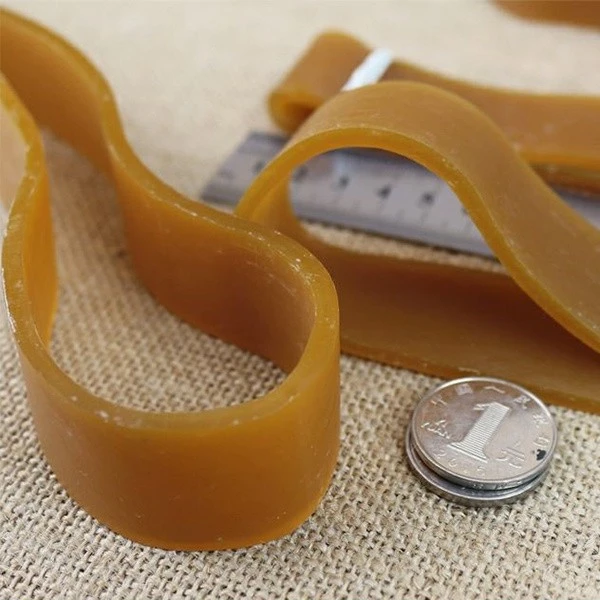
Let's say you're in the market for thick rubber bands. We offer a wide range of options. If you're looking for smaller ones, check out our Small Thick Rubber Bands. These are great for all sorts of applications, like bundling small items or for use in crafts.
If you need something bigger, our Large Thick Rubber Bands are the way to go. They can handle heavier loads and are often used in industrial settings or for securing large objects.
And for those specific needs where you require a 1 - inch thick rubber band, we've got you covered with our 1 Inch Thick Rubber Bands. These are ideal for more heavy - duty applications.
Now, let's get a bit more technical about measuring the modulus of elasticity of a thick rubber band. One common way is through a tensile test. In a tensile test, you attach one end of the rubber band to a fixed point and the other end to a device that can apply a pulling force. As you gradually increase the force, you measure how much the rubber band stretches.
You can then plot a graph of force versus stretch. The slope of the initial, linear part of this graph gives you the modulus of elasticity. For rubber bands, this relationship isn't always perfectly linear, especially when they're stretched a lot. But in the initial stages of stretching, it's a good approximation.
In practical applications, knowing the modulus of elasticity of a thick rubber band can be really useful. For example, if you're using rubber bands to hold together a stack of papers, you want a rubber band with a low enough modulus of elasticity so that it can stretch around the stack without breaking. But you also don't want it to be too elastic, or it might not hold the papers tightly enough.
If you're using thick rubber bands in a manufacturing process, say for making elastic components, the modulus of elasticity is crucial for ensuring that the final product performs as expected. You need to select the right rubber band with the appropriate modulus to meet the design requirements.
So, if you're interested in our thick rubber bands and want to know more about their modulus of elasticity or any other properties, don't hesitate to reach out. We're here to help you choose the right rubber bands for your specific needs. Whether you're a small business, a DIY enthusiast, or a large industrial company, we've got the products and the knowledge to support you.
We can have a detailed discussion about your requirements, and together, we can figure out which type of thick rubber band will work best for you. Contact us to start the conversation and let's get you the perfect rubber bands for your project.
References
- "The Physics of Rubber Elasticity" by L. R. G. Treloar
- Various industry reports on rubber materials and their properties