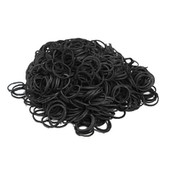

Common materials for rubber bands include natural rubber, synthetic rubber, latex and silicone. Each material has its own unique properties and application scenarios.Depending on the material of the rubber band, the price, function and use will vary.
1.Natural rubber rubber band
The ingredient is natural rubber, which is processed from the sap secreted by rubber trees. Its main ingredient is polyisoprene, which belongs to a high molecular polymer. It has high elasticity, high tensile strength, good tear resistance and wear resistance.
2.Synthetic rubber rubber band
TPR/SBS/TPE elastomer materials can be used for injection molding or extrusion processing and molding for rubber bands. The material is white, translucent or transparent particles, easy to match colors. Hardness Shore 30~50A, material properties, strong tensile strength and elongation at break, non-toxic and odorless materials, in line with ROHS, REACH, EN71 environmental testing standards. Compared with traditional rubber and silicone materials, rubber bands made of TPR/SBS/TPE raw materials are easier to produce and process. This type of rubber band is cheap, has high tensile strength, light specific gravity, and is easy to adjust the color.
3.Latex rubber bands
Latex rubber bands are similar to silicone rubber bands in processing methods, but the materials are different. Latex rubber bands have stronger tensile strength, soft and comfortable feel, and are suitable for applications that require strong tensile strength and good feel. However, latex rubber bands have a pungent smell, low environmental safety, and poor high temperature resistance. Long-term exposure to high temperature will affect the service life and tensile rebound strength.
4.Silicone rubber rubber band
Some silica gel is soaked in a chemical solution and then dried and activated to obtain color-changing silica gel. This is non-toxic and odorless, non-transformable, high temperature resistant, cold resistant, waterproof, transparent and anti-aging, and the product is brightly colored.