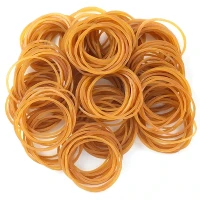

When sourcing rubber bands internationally, buyers often notice significant price differences between suppliers. Even products that look identical can vary greatly in cost.
So what truly determines rubber band pricing?
This guide explains the core rubber band cost factors, helping importers, wholesalers, and industrial buyers make informed purchasing decisions.
1. Raw Material Costs – The Primary Driver of Rubber Band Pricing
Raw materials account for the largest percentage of total rubber band production costs.
Material Type: Natural Rubber vs Synthetic Rubber vs TPR
Different materials result in major price differences:
Natural rubber rubber bands – High elasticity, superior tensile strength, longer lifespan, higher cost
Synthetic rubber bands – Moderate elasticity, more price stability
TPR rubber bands – Lower-cost alternative, suitable for light-duty use
Natural rubber is a globally traded commodity, and its pricing is influenced by:
Global supply and demand
Climate conditions in producing countries
Export policies
USD exchange rate fluctuations
As a result, rubber band prices can fluctuate throughout the year.
2. Manufacturing Process & Energy Consumption
Rubber band manufacturing involves multiple technical processes:
Rubber compounding
1
>>
Mixing and refining
2
>>
Extrusion or calendering
3
>>
Vulcanization (curing)
4
>>
Cutting
5
>>
Quality inspection
6
Each stage requires machinery, labor, energy, and technical expertise.
Custom rubber band production, non-standard sizes, or high-precision tolerance control will increase manufacturing costs.
3. Product Specifications & Performance Requirements
Size & Thickness
Larger circumference, wider width, or thicker rubber bands require more raw materials and lower production efficiency per unit, directly increasing costs.
Elasticity & Stretch Ratio
High-quality rubber bands that stretch 7–8 times without breaking require:
1.Premium natural rubber content
2.Optimized compound formulation
3.Strict tensile strength testing
Higher performance equals higher production investment.
Special Properties
Certain industries require enhanced performance such as:
1.Anti-aging resistance
2.High-temperature resistance
3.Oil resistance
4.UV resistance
5.Food-grade safety
Industrial rubber bands and medical rubber bands typically demand more advanced formulations.
4. Compliance & International Certification Requirements
For global export markets, compliance is critical.
Rubber bands that meet international standards such as:RoHS,REACH,EN71
require safer raw materials, lab testing, and stricter quality control systems.
Although certification increases production cost, it significantly reduces import risk and protects brand reputation.
Many buyers source rubber bands through trading companies. However, working directly with a rubber band manufacturer offers clear advantages:
1.Stable Raw Material Procurement
Direct factories purchase natural rubber in bulk, helping stabilize pricing during commodity fluctuations.
2.Better Cost Control
Without middleman margins, factory direct rubber bands provide more competitive pricing for bulk orders.
3.Customization Flexibility
Manufacturers can support:
Custom sizes
Custom colors
Custom packaging
Private label branding
Logo printing
4.Quality Consistency
Direct factories control the full production process, ensuring consistent elasticity, tensile strength, and durability across batches.
5.Faster Communication & Technical Support
Working directly with a rubber band factory improves efficiency in:
Sample development
Technical adjustments
Compliance documentation
After-sales support
6.Stable Production Capacity & On-Time Delivery
Reliable production capacity
Stable lead times
Timely shipment
Better support during peak seasons
This reduces supply risk and helps buyers maintain smooth inventory planning.
Conclusion
Rubber band pricing is influenced by multiple layers:
01
Raw material cost
02
Global rubber market fluctuations
03
Production complexity
04
Product specifications
05
Performance requirements
06
Certification compliance
Two rubber bands may look the same, but their lifespan, elasticity, and safety performance can differ significantly.
Choosing the right material grade and working with a reliable rubber band manufacturer is the key to long-term cost efficiency and supply stability.
If you are looking for custom rubber bands, bulk rubber band supply, or factory direct pricing, partnering with an experienced manufacturer ensures better value, better performance, and lower sourcing risk.