

Are pink rubber bands resistant to chemicals? This is a question that often comes up when customers are looking for reliable rubber bands for various applications. As a pink rubber bands supplier, I've had extensive experience and knowledge about the chemical resistance of these vibrant bands. In this blog, I'll delve into the topic to provide you with a comprehensive understanding.
Understanding the Basics of Rubber Bands and Chemical Resistance
Rubber bands are made from natural or synthetic rubber materials. Natural rubber is derived from the latex of rubber trees, while synthetic rubber is produced through chemical processes. The chemical resistance of rubber bands depends largely on the type of rubber used, as well as the additives and treatments applied during manufacturing.
When we talk about chemical resistance, we're referring to the ability of a material to withstand the effects of various chemicals without significant degradation. Chemicals can cause a range of problems for rubber bands, including swelling, softening, hardening, or even complete dissolution. The degree of resistance depends on the specific chemical involved, the concentration of the chemical, the temperature, and the duration of exposure.
Pink Rubber Bands: Composition and General Resistance
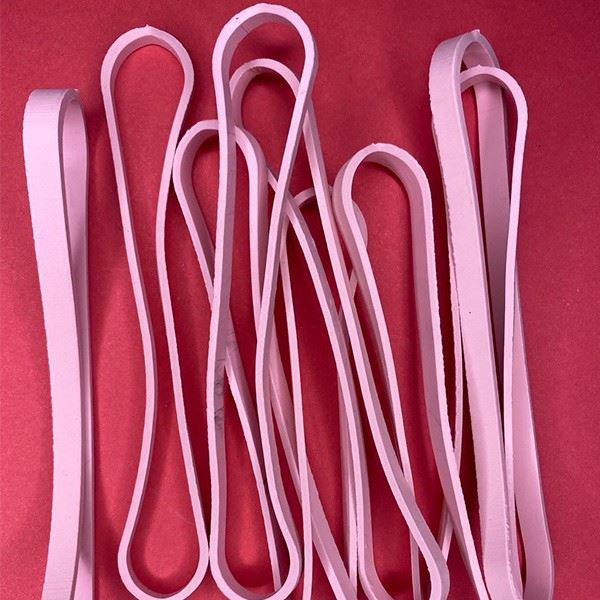
Our pink rubber bands come in different shades, such as light pink, hot pink, and large pink rubber bands. Large Pink Rubber Bands are often used for heavy - duty applications, while Light Pink Rubber Band and Hot Pink Rubber Bands are popular for decorative and general - purpose uses.
Most of our pink rubber bands are made from high - quality natural rubber. Natural rubber has some inherent chemical resistance, but it also has its limitations. It is relatively resistant to water, weak acids, and weak alkalis. For example, if you use a pink rubber band to hold a bunch of papers that might get slightly damp, the rubber band will likely remain in good condition. However, when exposed to strong acids or alkalis, natural rubber can quickly break down.
Synthetic rubber, on the other hand, can offer better chemical resistance in some cases. We also offer pink rubber bands made from synthetic rubber blends. These blends can be formulated to resist specific chemicals, such as oils, solvents, and certain industrial chemicals.
Factors Affecting Chemical Resistance
Chemical Type
Different chemicals have different effects on rubber bands. For instance, hydrocarbons like gasoline and oil can cause natural rubber to swell and lose its elasticity. If a pink rubber band comes into contact with gasoline, it may become soft and sticky, and eventually break. On the other hand, silicone - based rubber bands (a type of synthetic rubber) are more resistant to oils and hydrocarbons.
Concentration
The concentration of the chemical also plays a crucial role. A dilute solution of a chemical may have a minimal effect on a pink rubber band, while a concentrated solution can cause rapid deterioration. For example, a weak solution of vinegar (a mild acid) may not harm a natural rubber pink rubber band, but concentrated acetic acid can cause it to degrade.
Temperature
Higher temperatures generally accelerate chemical reactions. If a pink rubber band is exposed to a chemical at a high temperature, the degradation process will be much faster than at room temperature. For example, if a rubber band is used in a hot industrial environment where it comes into contact with chemicals, it will need to be made from a more heat - and chemical - resistant material.
Duration of Exposure
The longer a pink rubber band is exposed to a chemical, the more likely it is to be damaged. Even a relatively resistant rubber band can be compromised if it is in continuous contact with a chemical for an extended period.
Testing the Chemical Resistance of Pink Rubber Bands
To ensure the quality and chemical resistance of our pink rubber bands, we conduct a series of tests. We expose samples of our rubber bands to different chemicals under controlled conditions. We measure factors such as changes in weight, dimensions, and mechanical properties (such as tensile strength and elasticity) before and after exposure.
For example, we soak rubber band samples in various chemical solutions for a set period at a specific temperature. After the exposure, we carefully examine the samples. If there is significant swelling, discoloration, or a loss of mechanical properties, we know that the rubber band may not be suitable for applications involving that particular chemical.
Applications and Chemical Resistance Requirements
Office and Household Use
In office and household settings, the chemical exposure of pink rubber bands is usually limited. They are mainly used for holding papers, bundling items, or for decorative purposes. In these cases, resistance to water, mild detergents, and common household chemicals is sufficient. Our natural rubber pink rubber bands are well - suited for these applications.

Industrial Applications
In industrial settings, the requirements for chemical resistance are much higher. For example, in the automotive industry, rubber bands may be exposed to oils, fuels, and coolant chemicals. In this case, we recommend our synthetic rubber - based pink rubber bands, which are formulated to resist these harsh chemicals.
Medical and Laboratory Use
In medical and laboratory environments, pink rubber bands may come into contact with various chemicals, including disinfectants, reagents, and biological fluids. Our rubber bands used in these applications are made from materials that are resistant to a wide range of chemicals and are also compliant with relevant safety and hygiene standards.
Conclusion
In conclusion, the chemical resistance of pink rubber bands depends on several factors, including the type of rubber, the chemical involved, concentration, temperature, and duration of exposure. As a pink rubber bands supplier, we offer a range of products to meet different chemical resistance requirements. Whether you need rubber bands for office use, industrial applications, or medical and laboratory settings, we can provide you with the right solution.
If you're interested in purchasing our pink rubber bands and have specific chemical resistance requirements, we're here to help. Our team of experts can assist you in selecting the most suitable product for your needs. Contact us to start a discussion about your procurement requirements, and let's find the perfect pink rubber bands for your application.
References
- "Handbook of Rubber Technology" by Maurice Morton
- "Rubber Chemistry and Technology" published by the American Chemical Society