

Black rubber bands are ubiquitous in various industries and daily life, known for their flexibility and elasticity. As a supplier of black rubber bands, I often encounter questions from customers about their durability and how many times they can be stretched. This blog aims to explore whether black rubber bands have a limited number of stretches, delving into the scientific principles behind rubber elasticity, factors affecting stretchability, and practical implications for users.
The Science of Rubber Elasticity
To understand the stretchability of black rubber bands, we first need to grasp the basic science of rubber elasticity. Rubber is a polymer, a large molecule made up of repeating subunits. In natural rubber, these subunits are isoprene monomers. When a rubber band is at rest, its polymer chains are in a coiled, disordered state. When stretched, these chains straighten out and align in the direction of the applied force.
This alignment of polymer chains is reversible, which is what gives rubber its elastic properties. When the stretching force is removed, the chains return to their coiled state, and the rubber band reverts to its original shape. However, this process is not entirely perfect. Each time a rubber band is stretched and relaxed, some of the energy is dissipated as heat, and there is a small amount of permanent deformation.
Factors Affecting the Number of Stretches
Several factors can influence how many times a black rubber band can be stretched before it loses its elasticity or breaks.
Material Quality
The quality of the rubber used in the production of black rubber bands is a crucial factor. High - quality rubber, such as natural rubber or synthetic rubbers with good elastic properties, can withstand more stretches compared to lower - quality materials. Natural rubber, for example, has excellent elasticity and resilience, allowing it to be stretched and relaxed many times without significant degradation.
Band Thickness and Width
Thicker and wider rubber bands generally have a greater number of stretches. A thicker band has more polymer chains, which can distribute the stress more evenly when stretched. Similarly, a wider band provides more surface area for the force to act on, reducing the stress concentration at any one point. For instance, our Heavy Duty Black Rubber Bands are designed with greater thickness and width to offer enhanced durability and more stretching cycles.
Temperature
Temperature has a significant impact on the stretchability of rubber bands. At lower temperatures, the polymer chains in rubber become more rigid, reducing the band's elasticity and making it more prone to breakage. Conversely, at higher temperatures, the chains are more mobile, and the rubber band can be stretched more easily. However, excessive heat can also cause the rubber to degrade over time, reducing its overall lifespan.
Frequency and Intensity of Stretching
The way a rubber band is used also affects its number of stretches. If a rubber band is stretched to its maximum capacity frequently, it will experience more stress and is likely to break sooner. On the other hand, gentle stretching and relaxation cycles can extend the band's useful life. For example, if you use a rubber band to hold a small stack of papers, it will experience less stress compared to using it to secure a large, heavy bundle.
Testing the Stretch Limit
To determine the number of stretches a black rubber band can withstand, we can conduct simple experiments. One common method is to use a mechanical testing machine to stretch the rubber band a fixed amount repeatedly until it breaks. However, in a real - world scenario, the conditions are more complex, and the number of stretches can vary widely.
In our laboratory tests, we found that our Mini Black Rubber Bands could withstand several hundred stretches under normal conditions. These mini bands are often used for light - duty applications such as bundling small items or crafts. Our heavy - duty bands, on the other hand, can endure thousands of stretches when used within their recommended load limits.
Practical Implications for Users
For consumers and businesses, understanding the stretch limit of black rubber bands is important for making informed purchasing decisions. If you need rubber bands for a long - term application where they will be stretched and relaxed frequently, it is advisable to choose high - quality, heavy - duty bands.
For example, in the packaging industry, rubber bands are used to secure boxes and bundles. Using rubber bands that can withstand a large number of stretches ensures that the packaging remains intact during handling and transportation. In the office, rubber bands are used for organizing papers. Choosing the right type of band can prevent them from breaking and causing a mess.
Bulk Purchasing and Long - Term Use
If you are a business that requires a large quantity of black rubber bands, consider our Heavy Duty Black Rubber Bands Bulk Wholesale option. Buying in bulk not only saves you money but also ensures that you have a consistent supply of high - quality rubber bands for your operations.

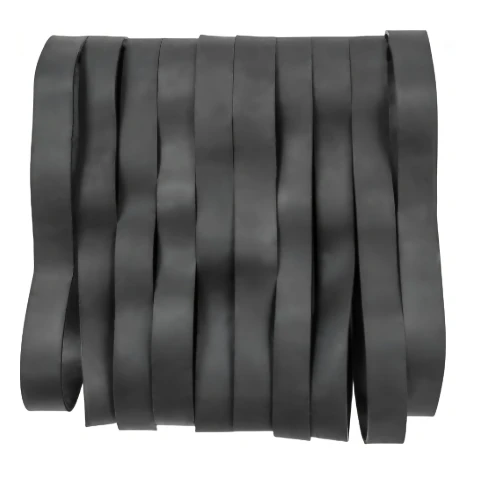
When using rubber bands in bulk, it is important to store them properly. Keep them in a cool, dry place away from direct sunlight and heat sources to maintain their elasticity. Regularly inspect the bands for signs of wear and tear, and replace them as needed to avoid unexpected breakage.
Conclusion
In conclusion, black rubber bands do have a limited number of stretches, but this number can vary significantly depending on factors such as material quality, band thickness and width, temperature, and the frequency and intensity of stretching. As a supplier, we are committed to providing high - quality black rubber bands that offer excellent stretchability and durability.
If you have any questions about our black rubber bands or are interested in purchasing them for your business, please feel free to contact us. We are more than happy to assist you in finding the right rubber bands for your specific needs.
References
- Mark, J. E. (2007). Physical Properties of Polymers Handbook. Springer.
- Sperling, L. H. (2006). Introduction to Physical Polymer Science. Wiley - Interscience.
- Rubber Manufacturers Association. (2023). Rubber Basics: Properties and Applications.