

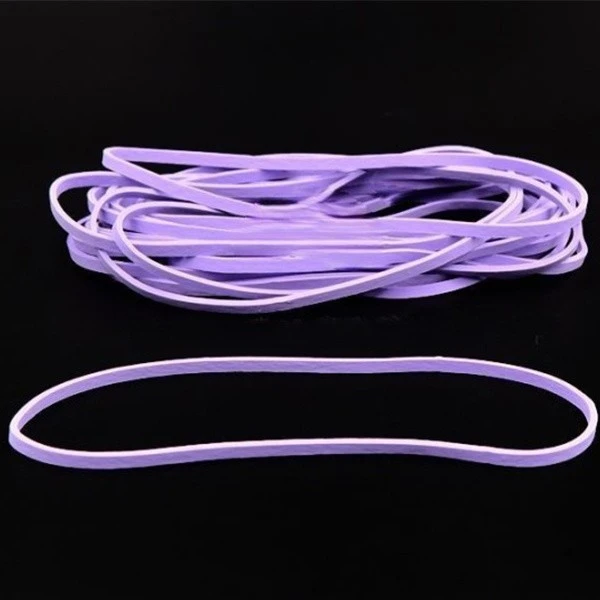
Purple rubber bands are a popular choice for various applications, from office use to industrial packaging. As a supplier of high - quality purple rubber bands, I often get asked the question: "Do purple rubber bands melt easily?" In this blog, I'll explore the factors that affect the melting point of purple rubber bands and provide a detailed answer to this common query.
Composition of Purple Rubber Bands
To understand whether purple rubber bands melt easily, we first need to look at their composition. Most rubber bands, including purple ones, are made from natural rubber or synthetic rubber. Natural rubber is derived from the latex of rubber trees, while synthetic rubber is produced through chemical processes.
The purple color in these rubber bands is achieved by adding colorants or dyes during the manufacturing process. These colorants are carefully selected to ensure they do not significantly affect the physical properties of the rubber, such as its melting point. However, the base rubber material plays a crucial role in determining how easily the rubber band will melt.
Melting Point of Rubber
The melting point of rubber is not as straightforward as that of pure substances. Rubber does not have a sharp melting point like ice or salt. Instead, it undergoes a process called softening and eventually degrades at high temperatures.
Natural rubber typically starts to soften around 100 - 120°C (212 - 248°F) and begins to degrade at temperatures above 150°C (302°F). Synthetic rubbers, on the other hand, can have a wider range of melting and degradation points depending on their chemical structure. For example, some types of synthetic rubber may start to soften at lower temperatures, around 70 - 80°C (158 - 176°F), while others can withstand higher temperatures before degrading.
Factors Affecting the Melting of Purple Rubber Bands
- Type of Rubber: As mentioned earlier, whether the rubber band is made of natural or synthetic rubber greatly affects its melting behavior. Natural rubber has different heat - resistance properties compared to synthetic rubber. Synthetic rubbers can be engineered to have specific heat - resistance characteristics, which means some purple rubber bands made from certain synthetic rubbers may be more heat - resistant than those made from natural rubber.
- Thickness and Size: Thicker rubber bands generally take longer to heat up and may be more resistant to melting compared to thinner ones. A thicker rubber band has more mass, which means it requires more energy to reach the temperature at which it starts to soften or degrade. For instance, Small Purple Rubber Band may be more susceptible to melting quickly due to its small size and relatively thin structure compared to larger rubber bands.
- Environmental Conditions: The environment in which the rubber bands are used also plays a role. If the rubber bands are exposed to direct sunlight for extended periods, the heat from the sun can gradually raise their temperature. Additionally, if they are used in an industrial setting where there are high - temperature machinery or processes nearby, the risk of melting increases. Humidity can also have an impact, as it can affect the physical properties of the rubber over time.
Real - World Applications and Melting Risks
In office settings, purple rubber bands are commonly used to bundle papers. The normal ambient temperature in an office is usually well below the temperature at which rubber bands start to melt. So, in this scenario, the risk of melting is extremely low.
However, in industrial applications, such as in packaging with Purple Pallet Rubber Bands, the situation can be different. If the packaged goods are stored in a hot warehouse or are transported in a vehicle exposed to high - temperature conditions, there is a potential risk of the rubber bands softening or melting. In food - processing industries, where strict temperature control is required, using rubber bands that can withstand the processing temperatures is crucial to avoid any contamination issues.
Our Purple Rubber Bands' Heat Resistance
As a supplier, we take great care in selecting the materials for our purple rubber bands. We offer a range of rubber bands made from different types of rubber to meet various customer needs. Our Purple Elastic Bands are designed to have good heat - resistance properties.
We conduct rigorous testing on our products to ensure they can withstand normal environmental conditions without melting or degrading. Our quality control team checks the heat - resistance of the rubber bands by subjecting them to simulated high - temperature environments. This way, we can guarantee that our customers receive rubber bands that are reliable and suitable for their intended applications.

How to Prevent Melting
If you are using purple rubber bands in an environment where there is a risk of high temperatures, there are several steps you can take to prevent melting.
- Proper Storage: Store rubber bands in a cool, dry place. Avoid storing them near heat sources such as radiators, ovens, or direct sunlight.
- Select the Right Type: Choose rubber bands with appropriate heat - resistance for your specific application. If you need rubber bands for high - temperature environments, consult with us to select the most suitable product.
- Monitor the Environment: Keep an eye on the temperature of the environment where the rubber bands are used. If the temperature starts to rise, take measures to cool the area or remove the rubber bands if possible.
Conclusion
So, do purple rubber bands melt easily? The answer is that it depends on several factors, including the type of rubber, size, and environmental conditions. In normal, everyday use, purple rubber bands are unlikely to melt. However, in high - temperature environments, there is a risk of softening and degradation.
As a supplier of purple rubber bands, we are committed to providing our customers with high - quality products that meet their requirements. Whether you need small rubber bands for office use or large pallet rubber bands for industrial applications, we have the right solution for you.
If you are interested in purchasing our purple rubber bands or have any questions about their heat - resistance properties, please feel free to contact us. We are more than happy to assist you in making the right choice for your needs and look forward to discussing your procurement requirements.
References
- "The Science of Rubber" by Rubber Manufacturers Association
- "Rubber Technology Handbook" by Werner Hofmann