

Do white rubber bands stick to things easily? That's a question I often get asked as a supplier of white rubber bands. Let's dig into this topic and find out what's what.
First off, we need to understand the basic properties of rubber bands. Rubber bands are made from rubber, which is a polymer. Polymers are long - chain molecules that give rubber its stretchy and elastic properties. White rubber bands are just like other rubber bands in terms of their basic structure, but they have that distinct white color, which might come from additives used during the manufacturing process.
Now, when it comes to sticking to things, there are a few factors at play. One of the main factors is the surface energy of the rubber band and the surface it comes in contact with. Surface energy is basically a measure of how attracted the molecules on the surface are to other molecules. If the surface energy of the rubber band and the object it touches are compatible, there's a higher chance of sticking.
Let's talk about some common scenarios. In a dry environment, white rubber bands usually don't stick to things very easily. The smooth surface of the rubber band doesn't have a lot of natural adhesiveness. For example, if you place a white rubber band on a clean, dry wooden table, it'll just sit there. You can easily pick it up without it leaving any residue or sticking firmly to the table.
However, things change when there's moisture or some kind of sticky substance involved. If the surface is wet or has a thin layer of grease or oil, the rubber band might start to stick. The moisture can act as a kind of glue between the rubber band and the surface. Say you're working in a kitchen and there's a bit of cooking oil on the counter. A white rubber band dropped on that oily surface will probably stick a bit, and it won't slide around as freely as it would on a dry surface.
Another factor is the temperature. In warmer temperatures, rubber can become a bit softer and more pliable. This increased flexibility can sometimes lead to better contact between the rubber band and the surface, increasing the chances of sticking. On a hot summer day, a white rubber band left on a metal object might adhere more than it would on a cold winter day.

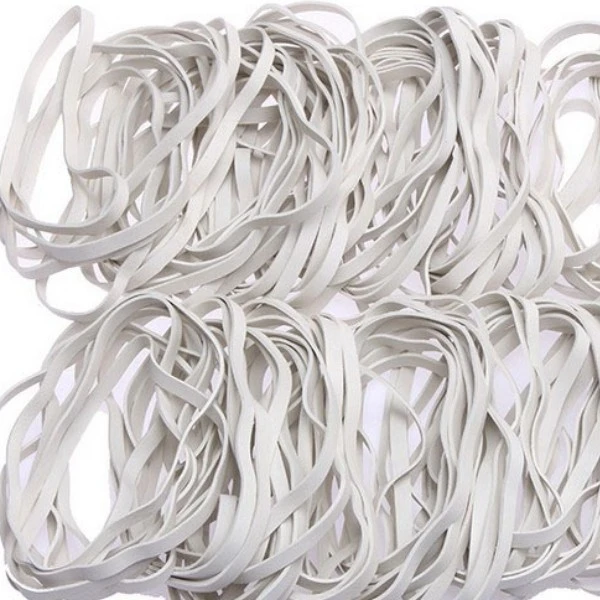
As a supplier, I offer a variety of white rubber bands to meet different needs. Check out our White Elastic Rubber Bands. These bands are known for their great elasticity, which means they can stretch a long way without breaking. Whether you're using them for bundling papers or for some DIY projects, they're a reliable choice.
If you need rubber bands with even more stretch, our High Elasticity White Rubber Band is the way to go. These bands are designed to withstand a lot of stretching and still maintain their shape. They're perfect for applications where you need a strong and elastic hold.
And for those looking for long - lasting rubber bands, we have the Anti Aging White Rubber Band. These bands are treated to resist aging, so they won't dry out or become brittle as quickly as regular rubber bands. This makes them ideal for long - term storage or use in environments where the rubber might be exposed to harsh conditions.
Now, let's get back to the question of adhesiveness. Sometimes, you might want your rubber bands to stick, like when you're using them in a craft project where you need them to stay in place. In such cases, you can use a bit of glue or a sticky spray to make them adhere better. But if you're in a situation where you don't want the rubber bands to stick, make sure the surfaces are clean and dry.
In industrial settings, the sticking properties of white rubber bands can be both a blessing and a curse. In some manufacturing processes, rubber bands need to be easily removable, so low adhesiveness is preferred. But in other cases, like when using rubber bands to hold labels in place during a packaging process, a bit of sticking can be useful.
To sum it up, white rubber bands don't have a high natural tendency to stick to things in normal, dry conditions. But factors like moisture, temperature, and the presence of sticky substances can change that.
If you're in the market for high - quality white rubber bands, I'd love to have a chat with you. Whether you're a small business owner looking for rubber bands for packaging or a hobbyist in need of bands for your creative projects, we've got the right products for you. Contact me to discuss your requirements and let's work together to find the perfect white rubber bands for your needs.
References
- Physics of Polymers: Concepts for Understanding Rubber and Plastics. This book provides in - depth knowledge about the properties of polymers, which are the basis of rubber bands.
- Handbook of Adhesion Technology. It covers various aspects of adhesion, including how different materials interact and stick to each other, which is relevant to our discussion of rubber band adhesiveness.