

As a supplier of natural rubber in various colors, I've often been asked whether the color of natural rubber affects its chemical resistance. This question is not only relevant to industries that rely on rubber products for their chemical - handling needs but also to consumers who use rubber items in different environments. In this blog, I'll explore this topic in detail, drawing on scientific knowledge and industry experience.
Understanding Natural Rubber
Natural rubber is a polymer derived from the latex of rubber trees, primarily Hevea brasiliensis. It has excellent elasticity, high tensile strength, and good abrasion resistance. These properties make it a popular choice for a wide range of applications, from rubber bands to industrial hoses.
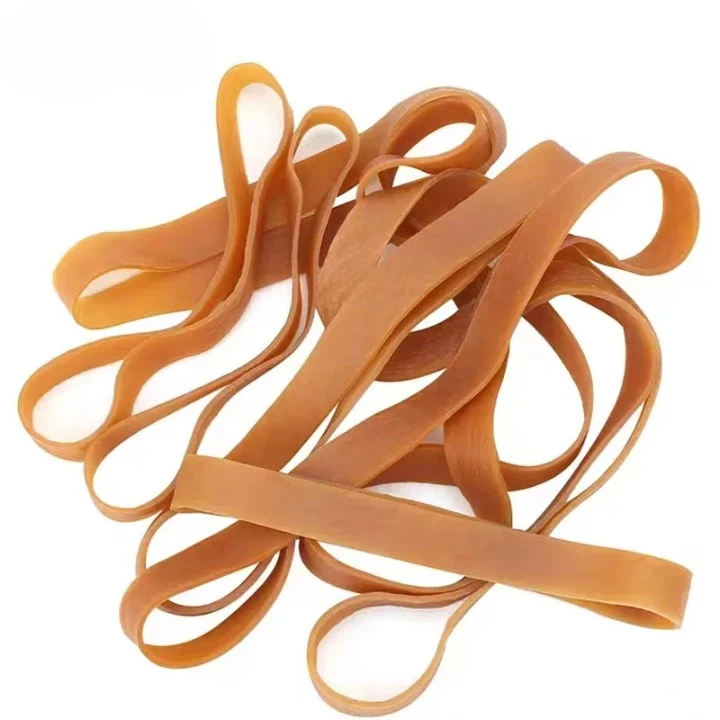
The color of natural rubber can vary. The raw latex is a milky - white substance, but during the processing, different colors can be achieved by adding pigments. The most common colors include white, black, red, blue, and green. These colored rubbers are used in various products, such as High Elastic Natural Rubber Bands, which are often used in office settings, and Large Natural Rubber Bands, which find applications in packaging and industrial uses.
Chemical Resistance of Natural Rubber
Before delving into the impact of color on chemical resistance, it's important to understand the general chemical resistance of natural rubber. Natural rubber has good resistance to water, weak acids, and weak alkalis. However, it is susceptible to attack by strong oxidizing agents, organic solvents, and oils.
The chemical resistance of rubber is determined by its molecular structure. The double bonds in the natural rubber polymer chain are reactive sites. When exposed to certain chemicals, these double bonds can react, leading to changes in the rubber's physical and mechanical properties. For example, exposure to strong acids can cause the rubber to harden and lose its elasticity, while exposure to organic solvents can cause swelling and softening.
Does Color Affect Chemical Resistance?
The short answer is that, in most cases, the color of natural rubber does not directly affect its chemical resistance. The pigments used to color the rubber are generally inert substances. They do not participate in the chemical reactions that occur when the rubber is exposed to chemicals.
However, there are some indirect factors related to color that could potentially affect chemical resistance. For example, the manufacturing process of colored rubber may involve additional steps or chemicals. Some pigments may require the use of dispersants or other additives to ensure even color distribution. These additives could potentially react with certain chemicals and affect the rubber's chemical resistance.
Another factor is the quality of the pigments. Low - quality pigments may contain impurities that could react with chemicals and compromise the rubber's chemical resistance. Therefore, it is crucial to use high - quality pigments from reliable suppliers.
Let's take a look at some specific examples. If we compare white and black natural rubber, black rubber is often made by adding carbon black as a pigment. Carbon black is a well - known reinforcing filler for rubber. It not only gives the rubber a black color but also improves its mechanical properties, such as abrasion resistance and tensile strength. In some cases, the presence of carbon black may also enhance the rubber's resistance to certain chemicals, such as ozone.
On the other hand, colored rubbers with organic pigments may be more sensitive to certain chemicals. Organic pigments can be more reactive than inorganic pigments, and they may break down when exposed to strong oxidizing agents or high - temperature environments.
Testing Chemical Resistance
To accurately determine the chemical resistance of colored natural rubber, it is necessary to conduct proper testing. There are several standard test methods available, such as ASTM D471, which measures the effect of liquids on rubber properties.
In a typical test, rubber samples of different colors are immersed in various chemicals for a specified period. The samples are then removed, and their physical properties, such as weight, volume, hardness, and tensile strength, are measured. Any changes in these properties indicate the degree of chemical attack.
It's important to note that the results of these tests can vary depending on the specific chemicals used, the exposure time, and the temperature. Therefore, it's essential to conduct tests under conditions that closely mimic the actual application environment.
Applications and Considerations
In industries where chemical resistance is critical, such as the chemical processing, pharmaceutical, and food industries, it is important to choose the right color of natural rubber based on the specific chemical exposure.
For example, in applications where the rubber will be exposed to strong oxidizing agents, it may be advisable to choose a rubber with a more chemically - resistant pigment or a natural rubber without added color. In contrast, in applications where the rubber is exposed to mild chemicals or water, the color may not be a significant factor.
When selecting colored natural rubber for a particular application, it's also important to consider other factors, such as the mechanical properties, durability, and cost. For instance, Premium Rubber Bands are often made with high - quality rubber and pigments, which can offer better overall performance, including chemical resistance.
Conclusion
In conclusion, while the color of natural rubber does not directly affect its chemical resistance in most cases, there are indirect factors related to the coloring process and pigment quality that could potentially have an impact. It is essential to understand the specific chemical environment in which the rubber will be used and choose the appropriate color and type of natural rubber accordingly.
As a supplier of natural rubber in various colors, I am committed to providing high - quality products that meet the diverse needs of our customers. Whether you need rubber bands for office use or industrial rubber products with specific chemical resistance requirements, we can offer you a wide range of options.
If you are interested in learning more about our natural rubber products or have specific requirements for chemical - resistant rubber, please feel free to contact us for a detailed discussion. We look forward to working with you to find the best solutions for your applications.

References
- ASTM D471 - Standard Test Method for Rubber Property - Effect of Liquids.
- Morton, M. (1987). Rubber Technology. Van Nostrand Reinhold.
- Mark, J. E., Erman, B., & Eirich, F. R. (Eds.). (2005). Science and Technology of Rubber. Academic Press.