

Hey there! As a supplier of natural rubber color, I've been getting a lot of questions lately about whether the color of natural rubber affects its fatigue resistance. I thought I'd take a deep dive into this topic and share what I've learned.
First off, let's understand what natural rubber is. Natural rubber is a polymer made from the sap of rubber trees. It's known for its excellent elasticity, resilience, and durability. But when it comes to color, natural rubber can vary from a light, almost translucent shade to a darker, more amber - colored tone. This color variation can be due to a few factors, like the type of rubber tree, the region where it's grown, and the processing methods.
Now, let's talk about fatigue resistance. Fatigue resistance in rubber refers to its ability to withstand repeated stress and strain without cracking, breaking, or losing its physical properties over time. When rubber is used in applications like bands, O - rings, or other flexible components, it goes through a lot of stretching, compressing, and bending. So, its fatigue resistance is super important.
The question is: does the color actually play a role in this fatigue resistance? Well, there isn't a one - size - fits - all answer.
On one hand, in theory, color itself shouldn't directly affect fatigue resistance. The chemical structure of natural rubber is what gives it its mechanical properties, including fatigue resistance. The color is just a result of impurities or natural pigments present in the rubber. As long as the rubber has been properly processed and vulcanized (a chemical process that cross - links the polymer chains in rubber, improving its strength and durability), the color shouldn't fundamentally change the way the rubber responds to fatigue.
However, there are some secondary factors related to color that might have an impact. For example, darker - colored natural rubber could potentially contain more impurities. These impurities could act as weak points in the rubber matrix. When the rubber is subjected to repeated stress, these weak points can initiate cracks, which then grow over time and reduce the overall fatigue resistance.

On the other hand, lighter - colored natural rubber might be a sign of a more refined or pure product. A purer rubber could potentially have fewer weak points and thus better fatigue resistance. But this isn't always the case. Sometimes, the processing methods used to achieve a certain color can actually introduce new issues. For example, heavy bleaching to get a very light - colored rubber could damage the polymer chains, which would in turn lower the fatigue resistance.
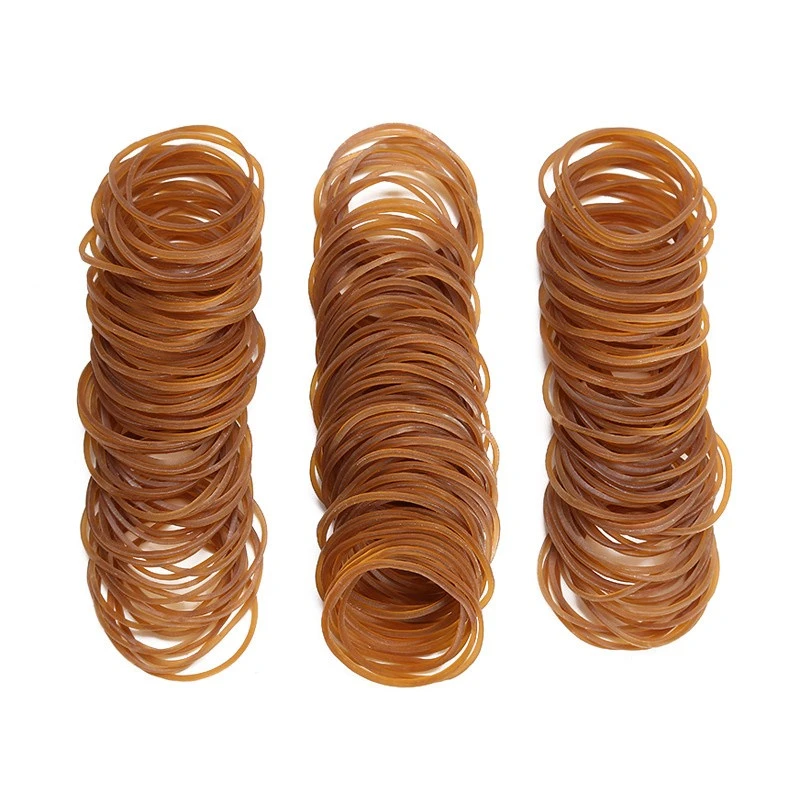
Let's look at some real - world examples. We offer Light Brown Natural Rubber Bands. These bands have a nice, warm color that comes close to the natural state of the rubber. Many customers use them for light - duty applications, like closing envelopes or holding a few pieces of paper together. In these low - stress applications, the difference in fatigue resistance based on color is hardly noticeable.
Our Large Natural Rubber Bands are used in more heavy - duty applications, such as securing large packages or bundling objects. In these cases, customers often wonder if a different color could give them better performance. While we haven't found a huge difference in fatigue resistance just based on color, we do know that proper vulcanization and quality control are much more important factors.
And then there are our Thick Natural Color Rubber Bands. These are designed for high - stress applications where the rubber will be stretched and compressed a lot. Since they're thicker, they generally have better fatigue resistance to start with. But again, the color doesn't seem to be a determining factor in how well they hold up under repeated stress.
In conclusion, while the color of natural rubber can be an interesting characteristic, it's not the primary factor when it comes to fatigue resistance. Other factors like proper processing, vulcanization, and the presence of impurities have a much bigger impact. If you're in the market for natural rubber products, focus more on the quality and performance that the product offers rather than just the color.
If you're interested in learning more about our range of natural rubber color products or have any questions about fatigue resistance and natural rubber, feel free to reach out. We're always here to help you find the right rubber products for your specific needs. Let's start a conversation and see how we can work together!
References
- "The Science of Rubber" by Rubber Science Institute
- "Natural Rubber Properties and Applications" in the Journal of Polymer Materials