

Hey there! As a supplier of colored rubber bands, I often get asked about what materials these colorful little things are made of. So, I thought I'd write this blog to spill the beans and give you all the deets.
First off, let's talk about the main ingredient in most colored rubber bands: natural rubber. Natural rubber comes from the latex of rubber trees, mainly the Hevea brasiliensis tree. This latex is a milky - white fluid that oozes out when the tree's bark is tapped. It's super stretchy and has great elastic properties, which is why it's such a popular choice for making rubber bands.
When we're making colored rubber bands, we start with this natural rubber latex. But just using the latex as it is would give us plain, colorless rubber bands. To add color, we mix in pigments. Pigments are finely ground particles that give color to the rubber. There are all sorts of pigments out there, and we can choose different ones to get the exact colors we want. For example, if we want a bright red rubber band, we'll use a red pigment.
The pigments we use are usually inorganic or organic. Inorganic pigments are made from minerals. They're really stable and can withstand high temperatures and harsh conditions. This means that the color of the rubber bands won't fade easily, even if they're exposed to sunlight or heat. Organic pigments, on the other hand, are made from carbon - based compounds. They can produce very bright and vivid colors, but they might not be as durable as inorganic pigments in some cases.
Now, not all colored rubber bands are made from 100% natural rubber. Sometimes, we use synthetic rubber. Synthetic rubber is man - made and is produced through chemical processes. There are different types of synthetic rubber, like styrene - butadiene rubber (SBR) and neoprene.
SBR is one of the most commonly used synthetic rubbers in making rubber bands. It's cheaper than natural rubber and has similar elastic properties. We often blend SBR with natural rubber to get a more cost - effective product. The blend can also have some advantages, like better resistance to abrasion and aging.
Neoprene is another type of synthetic rubber. It's known for its excellent resistance to oil, chemicals, and heat. If you need colored rubber bands that will be used in an environment where they might come into contact with oil or chemicals, neoprene - based rubber bands could be a great choice.
In addition to the rubber and pigments, we also add some other ingredients to the mix. For example, we use vulcanizing agents. Vulcanization is a process that makes the rubber stronger and more elastic. It involves heating the rubber with sulfur or other vulcanizing agents. This cross - links the rubber molecules, creating a three - dimensional network that gives the rubber band its shape and stretchiness.
We also use antioxidants. These help prevent the rubber from oxidizing and breaking down over time. Oxidation can make the rubber brittle and lose its elasticity, so antioxidants are really important to keep the rubber bands in good condition for a long time.
Now, let me tell you a bit about the different types of colored rubber bands we offer. We have Bulk Colored Rubber Bands. These are great if you need a large quantity of rubber bands for your business or project. Whether you're using them for packaging, crafts, or any other purpose, our bulk colored rubber bands come in a variety of colors and sizes.
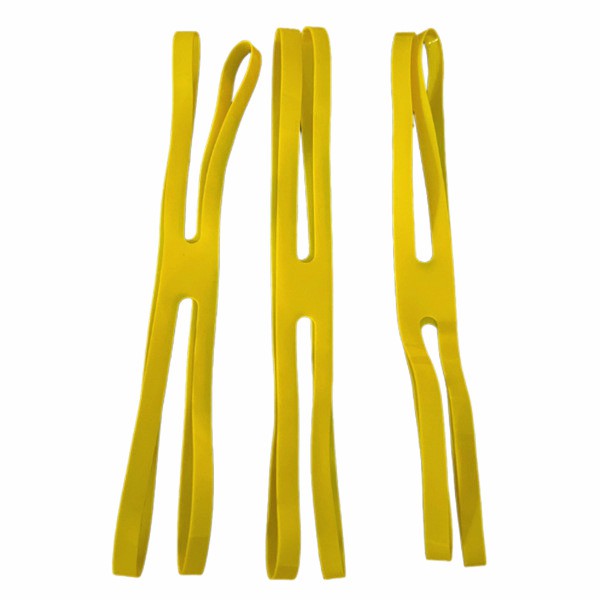
We also have H Bands Rubber Bands. These are a special type of rubber band with an "H" shape. They're really strong and can hold a lot of items together. They're often used in industrial applications, like bundling cables or securing packages.
And then there are our Thick Colored Rubber Bands. As the name suggests, these are thicker than regular rubber bands. They have more strength and can withstand greater tension. They're perfect for heavy - duty tasks, like holding large bundles of papers or securing heavy objects.
If you're in the market for colored rubber bands, we've got you covered. We can offer you high - quality products made from the best materials. Whether you need a small quantity for a DIY project or a large bulk order for your business, just reach out to us. We can have a chat about your specific needs and find the perfect colored rubber bands for you.
In conclusion, colored rubber bands can be made from natural rubber, synthetic rubber, or a blend of both. Pigments are added to give them color, and other ingredients like vulcanizing agents and antioxidants are used to improve their properties. With our wide range of products, you're sure to find the colored rubber bands that fit your requirements. So, don't hesitate to get in touch and start your procurement process!

References:
- "The Science of Rubber" by Rubber Manufacturers Association
- "Pigments in Polymers" by Society of Plastics Engineers