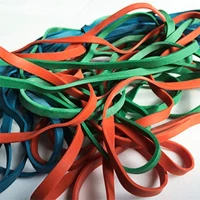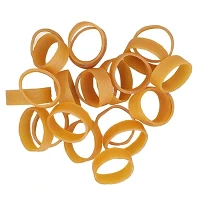

The fatigue resistance of a rubber band is often measured by the number of cyclic deformations a specimen undergoes before failure, or by the maximum stress amplitude corresponding to failure after a predetermined number of deformation cycles. The former is also called fatigue durability, and the latter is called fatigue strength. The main influencing factors are the following:
1. Stress-strain and mechanical properties. The fatigue resistance of a rubber band is closely related to the stress-strain characteristics of the rubber and some of its mechanical properties. There is a minimum critical deformation value for fatigue aging during vulcanization of a rubber band. The critical deformation value for vulcanized natural rubber bands is approximately 70%-80%. Below this fatigue resistance threshold, cracks are less likely to expand, resulting in very high fatigue durability.
2. The type of rubber. Different rubbers have different fatigue resistance and durability. Rubber bands are generally vulcanized using sulfur. The fatigue durability of sulfur-vulcanized rubber under compression and tension is 4% for natural rubber, and 30% for natural rubber. Therefore, to solve the aging problem of rubber bands.
solutions can be found from the above two aspects.