Introduction
Many buyers ask the same question: Who is the largest producer of rubber bands in the world?
In reality, there is no single company that dominates global production. Instead, rubber band manufacturing is concentrated in specific regions - with Asia playing a decisive role.
Understanding where rubber bands are produced helps buyers better evaluate supply stability, quality consistency, and long-term sourcing reliability.
Where Are Most Rubber Bands Produced Globally?
Most rubber bands used worldwide are produced in Asia, with manufacturing concentrated in China, Thailand, Malaysia, Indonesia, and India.
These countries are home to professional rubber band factories that operate at scale and specialize in different product segments, from standard office rubber bands to heavy-duty industrial bands.
Together, they supply large volumes of rubber bands for office supplies, packaging, agriculture, logistics, and industrial applications, supporting both daily consumption and bulk commercial use.
Their manufacturing capabilities allow them to meet diverse requirements in size, rubber content, elasticity, and packaging.
Asia's rubber band production is largely export-oriented, with a strong focus on overseas markets.
A significant portion of output is shipped to Europe, North America, the Middle East, and Africa, where local brands and distributors rely on Asian manufacturers for stable supply and consistent quality.
Why Asia Dominates Rubber Band Manufacturing?
1. Natural Rubber Materials Are Widely Available
Natural rubber is the main raw material for rubber bands, and Asia produces most of the world's natural rubber.
Local sourcing reduces transportation costs and ensures fresher raw materials.
This directly improves elasticity, tensile strength, and batch consistency.
2. Long and Mature Rubber Processing History
Rubber processing in Asia has developed over several decades.
Many factories accumulated experience through continuous production rather than short-term outsourcing.
This results in better control of compounding formulas and vulcanization processes.
3. Well-Developed Production Methods and Equipment
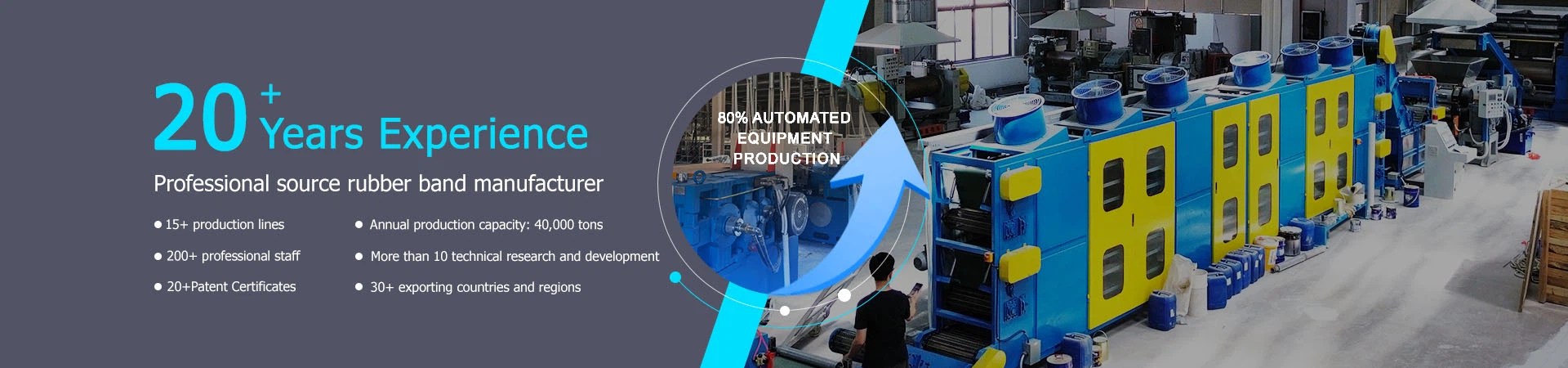
Asian rubber band factories commonly use automated extrusion, cutting, and vulcanization systems.
These systems improve efficiency while reducing human error.
As a result, manufacturers can produce large volumes with consistent quality.
4. Complete and Integrated Supply Chain
Asia has a highly integrated rubber industry supply chain.
Raw materials, additives, machinery, molds, and packaging are often sourced locally.
This shortens lead times and allows faster response to custom requirements.
Why Many Western Brands Do Not Own Factories?
Many rubber band brands in Europe and North America choose to focus on branding, sales, and distribution rather than operating their own manufacturing facilities.
Running a rubber band factory requires continuous investment in equipment, labor, environmental compliance, and raw material management, which increases long-term fixed costs.
Instead, these brands outsource production to specialized manufacturers in Asia, where rubber band manufacturing is already well established.
Asian factories typically offer mature production systems, trained technical teams, and scalable capacity, allowing brands to place both trial and bulk orders without heavy capital investment.
This sourcing model allows Western brands to reduce fixed operating costs while maintaining supply flexibility.
By working with experienced production partners, they can focus on market development and customer service, while relying on manufacturers to manage quality control, production consistency, and delivery schedules.
How Buyers Should Evaluate a Rubber Band Manufacturer?
When evaluating a rubber band manufacturer, buyers should look beyond price and focus on manufacturing capability and process control.
A reliable factory should be able to clearly explain its raw material selection, rubber content range, and how consistency is maintained across different production batches.
Production experience is another critical factor.
Manufacturers with long-term, stable production are usually better at controlling vulcanization time, elasticity, and tensile strength, which directly affect rubber band durability and performance in real applications.
Buyers should also evaluate a manufacturer's ability to support custom requirements and long-term supply.
This includes flexibility in size, width, packaging, quality standards, and the capacity to handle repeat orders without noticeable variation.
Conclusion
Asia has become the world's main rubber band manufacturing center due to its access to natural rubber, long processing history, mature production technology, and complete supply chain.
Rather than being dominated by a single largest producer, global supply relies on many specialized manufacturers across Asia, each serving different markets and applications.
As part of this manufacturing ecosystem, Daoak has accumulated practical experience by working directly with materials, production processes, and real customer requirements.
This hands-on involvement reinforces an industry reality: long-term quality and consistency come from controlled manufacturing, not from scale alone.